pursuing faithfulness to the Word of God and fullness of the Spirit of God
Posts tagged John Stott
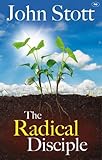
Book Review – The Radical Disciple (John Stott)
Feb 12th

There is a certain poignancy to this book – it is John Stott’s "farewell" – his final publication. Over the years he has produced dozens of books covering Biblical exposition right through to engagement with all kinds of contemporary issues. His book "The Cross of Christ" is certainly a contender for the best Christian book I have ever read, and his contributions to the Bible Speaks Today series are amongst the best on offer (Sermon on the Mount, Romans, Acts, Galatians, Ephesians, 1 & 2 Thessalonians, 1 Timothy & Titus, 2 Timothy). He is one of the most (if not the most) widely respected evangelical leaders in the UK, and deservedly so. So when he writes a "farewell" book, it’s definitely going to be worth paying attention to.
The book is a call for us all to be "radical disciples". To be radical is to be deep-rooted and whole-hearted. Stott picks out eight areas to explore in which we can become more committed followers of Jesus.
Our common way of avoiding radical discipleship is to be selective; choosing those areas in which commitment suits us and staying away from those areas in which it will be costly. But because Jesus is Lord, we have no right to pick and choose the areas in which we will submit to his authority.
The first area is non-conformity. Both escapism and conformism are forbidden to the believer. We are called to engage with our culture without compromise. Stott identifies four areas in which we need to refuse to conform: pluralism, ethical relativism, materialism, and narcissism (love of self).
The second area is closely related – Christlikeness is the will of God for the people of God. Stott takes us on a Bible-study showing the call to Christlikeness, some specific ways in which we are to be like Christ, and some implications of our Christlikeness. One of the reasons our evangelistic efforts fail is that we don’t look like Christ.
God’s purpose is to make us like Christ, and God’s way is to fill us with his Holy Spirit
The third area is maturity. Stott laments the fact that the modern church can be summed up in the phrase "growth without depth". He draws on Col 1:28-29 to bring out some aspects of maturity. In particular, we need a fresh vision of Christ, from the pages of Scripture. We must look for Christ as we read the Scriptures, in order to love, trust and obey him.
"Ignorance of Scripture is ignorance of Christ."
A fourth area is creation care. The simple fact that this chapter is here shows Stott’s commitment to applying Scripture to contemporary issues. He starts by building a biblical case for our responsible stewardship of the earth, avoiding the two extremes of deification of nature and exploitation of nature. He commends the work of tearfund and A Rocha, and calls us to be deeply committed to care for the creation. He quotes Chris Wright:
It seems quite inexplicable to me that there are some Christians who claim to love and worship God, to be disciples of Jesus, and yet have no concern for the earth that bears his stamp of ownership. They do not care about the abuse of the earth and indeed, by their wasteful and over-consumptive lifestyles, they collude in it.
A fifth area is simplicity. John Stott speaks from a position of integrity on this subject, since his book sales and speaking engagements could have made him a millionaire, yet he practices what he preaches, giving all his book royalties towards the work of providing books for believers and pastors in poorer countries. He feels grieved that the International Consultation on Simple Lifestyle which took place in March 1980 received very little attention, and this chapter is simply given to republish their statement (which he co-wrote with Ron Sider). This is a very challenging chapter, and one that exposes deep-seated idols that we are reluctant to part with. It is sad that Stott seems to be something of a lone voice in the evangelical world on this subject.
The sixth area is balance. In this chapter Stott expounds 1 Peter 2:1-17 and brings out three areas to hold in balance:
- Both individual discipleship and corporate fellowship
- Both worship and work
- Both pilgrimage and citizenship
The seventh area is dependence. He movingly speaks of his experiences of growing increasingly frail and weak. Humiliation is the road to humility. He notes that we start and end our lives completely dependent on others. We are not designed to be independent from one another: "You are designed to be a burden to me and I am designed to be a burden to you."
Christ himself takes on the dignity of dependence. He is born a baby, totally dependent on the care of his mother. He needs to be fed, he needs his bottom to be wiped, he needs to be propped up when he rolls over. And yet he never loses his divine dignity. And at the end, on the cross, he again becomes totally dependent, limbs pierced and stretched, unable to move. So in the person of Christ we learn that dependence does not, cannot, deprive a person of their dignity, of their supreme worth. And if dependence was appropriate for the God of the universe, it is certainly appropriate for us.
The final chapter deals with death. In it he explores from several angles the paradox of Christianity that death is the road to life. Our disicipleship involves a death to self. Our mission leads to the cross. He speaks of persecution and martyrdom, before moving finally to consider our mortality, and how death has been robbed of its horrors for the Christian.
Basic to all discipleship is our resolve not only to address Jesus with polite titles, but to follow his teaching and obey his commands.
In conclusion, this is a book you will want to read if you have had any contact with John Stott’s teaching ministry before. Though he is far too humble to say it about himself, it comes from a man who has fought the good fight, finished the race, and kept the faith (2 Tim 4:7). He has not asked us to do anything that he has not modelled first in his own life. It is a fitting farewell from a remarkable servant of God and I pray that his vision of radical discipleship will be fully embraced by the next generation.
William Temple on Christlikeness and the Spirit
Feb 6th
In John Stott’s Radical Disciple, in a chapter on Christlikeness, he cites William Temple:
It’s no good giving me a play like Hamlet or King Lear and telling me to write a play like that. Shakespeare could do it; I can’t.
And it is no good showing me a life like the life of Jesus and telling me to live a life like that. Jesus could do it; I can’t.
But if the genius of Shakespeare could come and live in me, then I could write plays like his.
And if the Spirit of Jesus could come and live in me, then I could live a life like his.
Stott concludes:
God’s purpose is to make us like Christ, and God’s way is to fill us with his Holy Spirit
Book Review – The Message of the Sermon on the Mount (John Stott)
Oct 9th

This exposition of the Sermon on the Mount was originally published under the title “Christian Counter-Culture”, before being added to the Bible Speaks Today series some years later. Although it only covers three chapters of Matthew, it is a worthy addition to the series, and allows the Sermon to be covered in much more depth than would otherwise be possible. The extra space however, is not devoted to surveys of the various theories about how the sermon came to be in the form it is, but the focus is always kept on practical application for today’s Christians.
While the book doesn’t strictly speaking have an introduction, the opening section on 5:1,2 effectively functions as one. Stott claims that the world is seeking for a counter-culture – a different, and better way to live, but have looked at the church and found confusion instead. He sees the sermon as a call to Christians to demonstrate a genuinely different way of life. He defends the sermon against criticism that it is inauthentic, irrelevant or unattainable. He also argues that it is not a gospel of righteousness by works, but it is a new law that leads us to Christ and shows us how to please God.
The beatitudes are set out as graces that all Christians need to manifest, and from the following verses he argues for Christians to be an influence for good in society. He sees Jesus’ antitheses as correcting distortions of the Mosaic law, to show that Christian righteousness is deeper than mere outward conformance to law.
Stott is careful not to make legalistic prescriptions about how the sermon should be applied, but still is willing to discuss many specific contemporary issues (e.g. pornography). His handling of the subject of divorce is gentle, and he includes an extended discussion of whether the non-retaliatory command should relate to the law courts. Basically, he tries to pick up on those verses which typical Christian readers might have questions about and works through the issues. As such it makes it a valuable resource for those who are studying or teaching their way through the sermon in a small group setting.
The first half of the sermon contains much material related to a Christian’s righteousness, while the second deals with prayer and Christian relationships. The sermon is broken down into 12 sections, and although he sometimes may be trying to be too neat with the structure he finds, it is a helpful way to organise the material.
There is not a great deal of discussion of how the sermon might have been heard by its original audience, and the political implications it would have had. He does however emphasise the multi-faceted “authority” of Jesus seen in the sermon, especially in the way he speaks of himself.
John Stott is convinced that the Sermon on the Mount is highly relevant teaching for today’s Christians. His practical focus throughout will mean that everyone will find something to challenge and inspire them. Reading through it should not prove difficult thanks to Stott’s good writing skills and devotional warmth. It will also serve as a good companion to any introductory commentary on Matthew, which will not typically be able to afford so much space to the sermon.
Book Review – The Message of Galatians (John Stott)
Jul 4th
Posted by Mark Heath in Book Reviews
3 comments
Paul is writing, he argues, to the churches in South Galatia to defend his apostleship and his gospel, both of which have come under attack from false teachers. Stott often points out that Paul still has many modern day opponents who deny his authority and reject his gospel message.
Each chapter of Galatians is dealt with in three or four chapters in the commentary. Stott sees Galatians as more or less falling into three main parts which roughly correspond to two chapters each. The first (Gal 1,2) deals with a question of authority. Paul defends his authority based on his apostleship. Those who are familiar with Stott’s writings will know how keen he is to emphasise the uniqueness of the 12 apostles, and his denial of any kind of apostolic succession or modern day apostles, both of which he would view as challenging the apostolic authority of Scripture.
The second section (Gal 3,4) deals with a question of salvation. The gospel is presented as salvation through the death of Jesus Christ, and is received by faith alone. He sees the false teachers as proponents of salvation through keeping the law as a necessary ’supplement’ to what Christ has done. He shows how the law of Moses ("thou shalt…") is contrasted to God’s promises to Abraham ("I will…"), and therefore the gospel is analogous to the promise, not the law. He regularly quotes Luther in this section.
The significance of the law is to show us our need of the gospel. Stott argues that this step cannot be bypassed – we must let the law show us our sin, before we can understand what the gospel is. Come to Moses first, and let Moses lead us to Christ.
The third section (Gal 5,6) deals with a question of holiness. Up until now, Paul’s message of Christian liberty may lead some to assume that anything goes in terms of behaviour. But liberty does not mean license. Stott argues that Christian freedom is primarily a freedom of conscience – we are not guilty before God. But freedom from law does not mean freedom from keeping the law - our sanctification involves us fulfilling the law, which Paul says is summed up in the command to love your neighbour (Gal 5:14). Similarly, we are called to fulfil the law of Christ (Gal 6:2).
Stott argues that the Christian has a conflict between what he is by nature (the flesh) and what he is by rebirth. In both Gal 5 and Rom 7 Paul presents walking by the Spirit as the solution to this conflict. We have nailed our flesh to the cross, but we need to keep it there until it dies. He describes holiness as a harvest. Paul speaks in Gal 6:8 about whether we sow to the flesh or to the Spirit. Holiness then is not automatic, but depends on where and how we sow.
Although the book has no introduction, a summary section at the end reiterates the main themes of the book and its key points for application. There is also a study guide at the end.
As with John Stott’s other contributions to the Bible Speaks Today series, this volume comes highly recommended. Due to its age, he does not address the question of the "New Perspective on Paul" (in particular, were the false teachers really teaching salvation by works?), and perhaps his approach to the issue of modern day apostles would be tempered by some of the clarifications that have been made by groups such as newfrontiers (that modern day apostles are not seen as having an authority equivalent to the 12, who were unique in that sense). I also felt that he could have explored more what it means to walk in the Spirit. Stott makes several comments throughout the book to state that the church are the inheritors of the Old Testament promises, and are in full continuity with the Old Testament believers, which is another key theme found in Galatians.
The strength of this commentary is an uncompromising proclamation of the message of salvation by grace alone, through faith alone, in Christ alone. Having laid this foundation, Stott then goes on to show how exhortation to holiness is not in conflict with this message. It will prove a valuable resource for anyone wanting to study or teach through the book of Galatians.