pursuing faithfulness to the Word of God and fullness of the Spirit of God
Word and Spirit
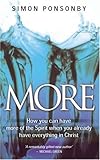
Book Review – More (Simon Ponsonby)
May 11th
This is Simon Ponsonby’s first book, published in 2004. I have also reviewed his more recent book on the Holy Spirit – God Inside Out.
In the early chapters he sets forth the desperate need for the church to seek a deeper, fuller, more intimate knowledge of God. He deals with various objections that might be raised against seeking more. These include the objection that at the cross we were given everything, and thus to ask for more is to claim it was not enough for us. Ponsonby argues that it is not more than the cross we need, but more ongoing reception of its benefits. He points out that Paul, while rejoicing in what is already ours in Christ, continually prays for more.
Similarly, one could object to seeking more of the Spirit by arguing that we have been already given the Spirit. But again, he goes to the Scriptures to show that we can have more of the Spirit, and he can have more of us.
That Paul can even make this command to be filled [Eph 5:18] implies that many believers are not. It is not to deny that they have the Holy Spirit, but simply to say that they could have more – or we might say that he could have more of them.
As well as theological objections, he deals with other blockages that stop us from seeking more of God. Often we have no expectation and no appetite. We shy away from yielding our lives fully. We need a holy discontent that drives us to seek more. This is not a mark of immaturity but maturity.
The desire for more of God is a sign of spiritual health. The mature want more.
He examines Pentecost and particularly emphasises that the Spirit empowers for evangelism. We must be prepared to go if we wish to be filled with the Spirit. So often the church is content with ministers who have theology degrees, when what it needs is to be a people filled with the Spirit’s power. We are urged to prepare for Pentecost through repentance, obedience, unity and prayer.
God is a promise-maker and a promise-keeper, but are we promise-seekers and promise-takers?
The person who would have more of God must give more to God. … Do you desire more of God? Then yield to him.
Chapter six deals with the potentially controversial issue of the “baptism in the Holy Spirit” (for my own take on this, see here). He makes it clear that he does not subscribe to a Pentecostal doctrine of a “once-for-all second blessing.” There should be a “constantly repeatable, deepening experience of God’s Spirit”. He emphasises God’s sovereignty in dealing with different people in different ways (a “tailor-made” experience of the Spirit). He moves on to examine all the texts that will be more than familiar to anyone who has worked through this debate before. Acts 8 he sees as an exception, and in Acts 19 he views the disciples of John the Baptist as not yet saved. He attempts to appease the Pentecostals by suggesting that they have the right experience despite the wrong doctrine!
Chapter seven tells his personal testimony which is a fascinating story of being brought up in a devout evangelical setting yet going away from God, and being drawn back to him and being filled with the Spirit.
The book is then rounded off by a chapter that deals with the issue of “wilderness”. In it he argues that the Spirit is given from the cross. He shows how many in the Bible met God in the wilderness, and offers some correctives to an overly triumphalistic understanding of the Spirit’s work.
The deep things of God are learned in the fiery furnace of the desert. It is here that he digs deep wells of his Spirit into our life.
Simon is great at filling his writing with memorable quotes and vivid illustrations. I can imagine that a couple of the chapters will seem a bit on the technical side for those who have not encountered some of the objections or alternative views he deals with. But the real value of this book is simply in the call to hunger for more intimacy with Christ. This is a message we cannot hear too often, and therefore I would highly commend it to anyone. Read it and be stirred afresh to seek God with all your heart.
Word and Spirit
Oct 25th
Ever since naming my blog “Word and Spirit”, I have always been on the lookout for Biblical passages and themes that relate these two topics together. Initially, I tended to think of “Word and Spirit” in a purely ecclesiological sense – a “Word and Spirit” church is one that values both sermons and spiritual gifts. Most churches who present themselves as “Word and Spirit” are trying to indicate that they have this dual emphasis on preaching and pneumatology.
But over the last years I have noticed many ways in which the Word of God and Spirit of God work together in the life of an individual believer. I began gathering material, with the intention of writing a short book that I would make freely available to readers of this blog and friends (already two people have offered to buy it if I put their names in the foreword!).
So I was looking for opportunities to develop the material by teaching it, and last Sunday I had the chance to preach at a Sunday night student event at my church. I based the talk on the metaphors of the Word of God as our spiritual food and the Spirit of God as our spiritual drink.
I had far too much to say in the time I had available (I skipped over at least 10 points!), and was worried it would come across as more of an “information blast” than a sermon, but people seemed positive about it. I’ve put my notes online in PDF format here for those who are interested: “Being Filled with the Word and Spirit“. If the mp3 gets made available I’ll put a link to it as well.
The more I think about it, the more convinced I am that a charismatic evangelical spirituality is simply a life filled with the Word and Spirit of God. This involves being a “self-feeder” (as Willow Creek have just “discovered”), by regularly coming to meet God in private in the Word and prayer, but also encountering God in his Word and by his Spirit in community, as we enjoy a “Word and Spirit banquet” with other believers when we meet together.
Anyway, my next steps are to organize my material into chapters, and I’ll post them one at a time on this blog as they are complete, so you can be my proof-readers and editor if you like!
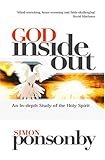
Book Review – God Inside Out (Simon Ponsonby)
Aug 30th
All the evangelical books on the Holy Spirit I have read seem to fall into two categories. First are the books by cessationists, who focus on the Spirit’s role within the godhead, his work in creation and regeneration and his ongoing role in sanctification. The charismatics on the other hand tend to quickly skip by these aspects so they can get to the more exciting and dynamic topics of power, baptism in the Spirit and gifts of the Spirit. I have been waiting for some time to find a book that adequately covers both sides of the story.
So I was quite excited to discover Simon Ponsonby’s God Inside Out book, which is subtitled, “An In-Depth Study of the Holy Spirit”. It is 332 pages long, which is long enough to cover a broad range of topics, but not so long that it effectively becomes a reference book. It had its genesis as a 15 week “school of theology” course he ran, and the continuity can be seen throughout the book.
Part One – The Holy Spirit and God
In the first section, he introduces the doctrine of the Holy Spirit, arguing for his divinity and showing the different biblical titles and pictures of the Spirit. One of the strengths of the book is the interest he has in church history, and there are lots of quotes from various church fathers and theologians. He has a good way of explaining complex debates in simple terms, and is willing to both learn from and critically evaluate the insights of previous generations.
In speaking of the person of the Spirit, Ponsonby portrays him as the “God we experience, the God who encounters us”. So while the discussion is theological and even academic, his passion that we would encounter God the Holy Spirit rather than merely understand him shines through.
We must not attempt to domesticate this wild wind of God – rather we must inhale deep draughts of this vivifying divine life, setting the sail to be carried wherever he wills.
In a chapter on Jesus and the Holy Spirit, he follows Pinnock in arguing that ”The Son’s self-emptying meant that Jesus was compelled to rely on the Spirit … the Son decided not to make use of divine attributes independently but experience what it would mean to be truly human.” I think this understanding of Jesus’ operating as a man under the power of the Spirit is vital to our own understanding of what it means to be a follower of Jesus. However, he cautions us that the parallel is perhaps better drawn between Jesus and the church – together as the body of Christ we walk in his example as a people filled with the Spirit.
Part Two – The Holy Spirit and the World
This section deals with some tricky subjects, including the Spirit’s role in Creation, and asks questions of what ways in which the Spirit is active in the world outside of the church & believer. Ponsonby interacts with various liberal theologians who see the Spirit at work in secular movements for political justice as well as in works of art.
The Spirit-led ministry of Christ was to the whole of man, not just the soul. … We are not saved on the basis of our ministry to the needy, but proof that we are saved is found in our ministry to the needy.
Part Three – The Holy Spirit and the Christian
This section deals quite brilliantly with regeneration, and moves on to consider the Spirit’s role in sanctification, and our sonship. One interesting theme he develops is that our salvation does more than restore us to our pre-fallen state – we are raised to a higher place than Adam was, seated with God in the heavenly places, and co-heirs with Christ. He also laments that sanctification is being neglected in the church at present.
Regrettably in the late twentieth and early twenty-first centuries, sanctification as a theological foundational doctrine, and holiness as a personal and communal imperative, do not seem to be high on the agenda. Holiness has become a dirty word, as the Church has become rather dirty.
The chapter on satisfaction seems to be a condensed version of his book “More: how you can have more of the Spirit when you already have everything in Christ“. I was struck by his observation that the “works of the flesh” list in Gal 5 can be seen as “human attempts to find the satisfaction which the Spirit alone brings.” He presents the satisfaction the Spirit brings as being “love unfathomable, joy unspeakable, peace unshakable and a stream unstoppable”.
The final chapter in this section is on power. He interprets Acts 1:8 as not promising power (i.e. boldness) for witness, but promising power (i.e. for attesting signs and wonders) that would accompany their witness. He argues that “God never withdrew the power of the Spirit to work signs and wonders”, drawing on Stanley Burgess’ research.
Part Found – The Holy Spirit and the Church
The final section is on the Spirit and the church. He starts off with an examination of the ever-controversial “baptism in the Spirit”, which he sees as being for joining to the church and equipping for ministry. It is this concept of being joined to the church that causes him to take up a “third wave” position, in seeing this as being another term for regeneration.
His arguments against a subsequence viewpoint are the main ones found elsewhere – it makes out that two-millennia of Christians are “second-class”, and sees 1 Cor 12:13 as insisting that Spirit baptism is a universal Christian experience. He claims that Luke uses “saved” and “granted repentance” interchangeably with “baptism in the Spirit”, but I did not find this convincing. He is also convinced that Acts 19 refers to unbelievers. I was disappointed to find that he had not interacted with Pawson’s view, which seems to have been ignored by every third wave theologian I have read.
Having said all this, the chapter takes a surprising turn as he considers the position of the Church Fathers who taught a post-conversion reception of the Spirit through the imposition of the laying-on of hands. He develops this theme to talk about a “divine equipping for service” or “transmission”, which “may come suddenly like a violent wind, or gradually like the rising of the sun.”
The chapter on gifts of the Spirit does not go into great depth, but gives broad definitions of many of the gifts listed in Scripture. They are not to be understood as natural giftings, but all are given supernaturally by the Spirit. The section on cessationism is very helpful as he tracks the gifts throughout history and considers why their use has been lacking for much of the time.
There are some other great chapters in this section. One on the Spirit and the Word considers how the Spirit speaks through Scripture, but also outside of Scripture. He suggests that the Puritans understood this better than the Reformers.
The book closes appropriately with the Spirit’s role in mission, from which it gets its title. The Spirit is “God inside out to bring those outside in”. The Spirit is not given simply for our personal benefit, or even for our church to be blessed, but that the world might be reached with the gospel of Jesus Christ.
Conclusion
If you’re looking for a well-rounded theology of the Spirit that will engage your mind and heart, look no further. I have underlined quotes on almost every page. Its a much more stimulating way to learn about the Spirit than simply reading the relevant chapters in a systematic theology. Read it and get a bigger picture of who God the Holy Spirit really is.
Book Review – Christ’s Radiant Church (John Hosier)
Aug 4th
This book is of particular interest to those who like myself are part of the newfrontiers family of churches. In it, John Hosier seeks to set out what are the values of the “new churches” that have sprung up over the past 30 years and of newfrontiers in particular.
Most of the material in this book will not come as a surprise to those who know the movement well. It starts off reiterating an uncompromising passion for the church, which is “fundamental to God’s glorious purpose in the earth.”
I suspect that most, if not all, the chapters in this book were originally seminars or sermons given by John Hosier, edited slightly to make them more suitable for a book format, but it still retains the style of spoken rather than written word. He draws regularly on his thorough knowledge of the book of Revelation, as well as touching on many other Biblical passages as he goes through each theme.
The first chapter is on the topic of Restoration, which is interesting as I feel that this word has been largely lost from the vocabulary of the new churches. “God’s ultimate purpose is restoration”, and this purpose will be accomplished through establishing his church as a colony of heaven on earth. Thus the restoration of the church to match God’s intention as revealed in the scriptures is a matter of the utmost importance. The church is restored in order to be the demonstration of God’s wisdom to the world.
Salvation is listed as a core value, particularly that the church is made up of those who are saved. He expounds Rom 3:21-26, and underscores the newfrontiers’ commitment to a vicarious understanding of the atonement.
As would be expected, apostles and more generally “Ephesians 4″ ministries are covered in some depth. The case is made that while the “twelve” and the apostle Paul are understood to have non-repeatable roles in church history, nonetheless the ministry of “apostle” is ongoing, and indeed one of the gifts that Christ gave the church after his ascension.
This moves on naturally to a discussion of God-given leadership, which is considered vitally important. The main leadership of churches is seen in teams of elders (not apostles), who are to exercise servant leadership.
Next up is God’s lavish and undeserved grace, which perhaps is one of the “flagship” doctrines newfrontiers churches seek to be known for. Avoiding legalism at all costs, the Christian is to look to the Holy Spirit rather than the law as the dynamic for a holy life.
There are two chapters on water baptism and Spirit baptism (fire). Newfrontiers churches practise believer’s baptism, and remain broadly Pentecostal in their doctrine of the baptism in the Holy Spirit. The latter remains the more controversial doctrine, with many prominent charismatics equating the baptism in the Spirit with regeneration. However, Hosier puts forward a strong case, based in part on Lloyd-Jones, and also drawing from David Pawson, that the baptism in the Holy Spirit is a distinct experience, though we should normally expect it soon after conversion.
In a chapter on worship he defends the more lively style of the new churches against the more formal worship of traditional churches, although this debate has moved on a long way now from when the new church movements began. Another chapter deals briefly with the charismatic gifts of tongues and prophecy, again a significantly less controversial topic than it was in the early days of the restorationist movement.
I was interested to see a chapter devoted to prayer. Certainly the new churches have a very different and more dynamic style of prayer meetings than those typically found in the traditional denominations. However, my personal experience is that there were far more prayer meetings in my old Baptist church than I have found in newfrontiers. Possibly this is a value that needs to be recovered.
The chapter on money emphasises the importance of cheerful, generous giving, while rejecting the tithe as a binding law on New Testament believers. Marriage and family each had a chapter of their own. Again the emphasis on these topics varies greatly from church to church.
The topic of women is probably the most controversial in the book, as newfrontiers retain the more traditional evangelical view known as complementarian, against the egalitarian approach which seems to be more prevalent in charismatic circles. Hosier argues carefully but firmly, working mainly from 1 Cor 11 (the passage on head covering), explaining why newfrontiers churches do not appoint female pastors or elders. He did however note that there was a diversity of practise in regards to whether women could preach. I think that this is an issue that does need some clear teaching on, as many churches prefer simply not to mention it and hope that no one asks!
The book then moves on look at the kingdom (already not yet) and mission, underscoring the commitment to plant churches as the primary means of extending the kingdom.
The chapter on flexibility is very interesting. In it John Hosier lists a number of issues over which there has been a change of direction. For example, some churches are now embarking on building projects, having originally intended to avoid doing so. Other changes include various models of house group or “cell group” being tried. I couldn’t help thinking that it wasn’t so much that flexibility is a core value as that we have backed away from a more dogmatic and inflexibile idealism of the early days of restorationism. Whether this is a good thing or not is debatable.
The final chapter is on hope, and again we possibly see a modification of the more postmillenial roots of restorationist churches. John Hosier himself holds to an amillenial eschatology, but an “optimistic” one, in which the church does indeed experience triumph and restoration while at the same time there may be persecution and even apostasy.
After reading the book, I reflected on what the “missing” values were. Perhaps we might have expected to reiterate a confidence in the Bible as the Word of God, along with the conviction that we can find direction for the ordering of our churches in it. Also I felt that preaching and holiness deserved a mention. I don’t think the omission of these mean that they are not valued, but we should be careful lest they be taken for granted. Many in the new churches came out of reformed evangelical circles and so a thorough working knowledge of the Bible was second nature to them. We do need to ask though whether the next generation, those who grew up in the new churches, are getting a well rounded foundation, or whether we are so focused on the values that make us distinctive, that these other things get neglected.
Overall, it is a fascinating book for those in newfrontiers, and it will hopefully challenge all who read it to consider whether these “values” are really being believed and lived out in our churches. If it has a weakness, it is that a book of this length cannot really do justice to such a broad range of topics.
A Secular Church?
Jul 17th
Dave Bish posted an interesting link to a lecture by Mark Dever on why Jonathan Edwards got fired. In it he quoted J H Thornwell, a Southern Presbyterian Theologian who wrote in 1832 concerning his denomination:
Our whole system of operations gives an undue influence to money. Where money is the great want [i.e. need], numbers must be sought, and where an ambition for numbers prevails, doctrinal purity must be sacrificed. The root of the evil is in the secular spirit of all our ecclesiastical institutions. What we want is a spiritual body, a church whose power lies in the truth and the presence of the Holy Ghost. To unsecularise the church should be the unceasing aim of all who are anxious that the ways of Zion should flourish.
(quote is 32 minutes into the MP3)
Surprising how relevant it seems to our own day (perhaps the ‘church growth’ movement is not as novel as some think). I also like the way he goes beyond a mere diagnosis of the problem to highlight the need of the church to be one whose power is found in “the truth and the presence of the Holy Ghost”. Or as we might say today – a church of “the Word and the Spirit”.
Charismatic Spiritual Formation
Apr 17th
I have been reading Dallas Willard’s book the Great Omission recently (book review to follow shortly), which is largely about spiritual formation. Although I don’t think he classes himself a charismatic, a brief comment on the gifts of the Spirit in one of his chapters got me thinking about the relationship between spiritual gifts and spiritual disciplines.
Spiritual formation – the process of our character being transformed to be more like Jesus – is brought into effect by spiritual disciplines and spiritual gifts.
Spiritual disciplines are those things we do to promote growth to Christian maturity in our own lives. This include such things as Scripture memorisation and meditation, private prayer and worship, and Dallas Willard would add things such as fasting, solitude, silence, frugality (exercises which are not often emphasised in charismatic circles for various reasons – often because they are thought too ascetic or legalistic).
Spiritual gifts are those things we do to promote growth to Christian maturity in the lives of others. As Paul makes abundantly clear in 1 Cor 12-14, the gifts are primarily for edification (building others up). Their purpose is not to show how spiritual we are, or even to give us self-esteem because we are being “used”, but to promote growth in one another.
So we could say that spiritual gifts and spiritual disciplines are two means to the same end. But they are not alternatives, as though the charismatics can choose the gifts path to holiness and the “emerging church” types can choose the disciplines path. We cannot become more like Jesus in isolation from his body (the church), but neither can we expect to grow in Christlikeness if we ignore our personal devotional lives and rely solely on input from others in meetings. The two must go hand in hand or we will remain spiritually immature.
Book Review – Convergence (Sam Storms)
Apr 7th
Those of us who classify ourselves as both “reformed” and “charismatics” have probably had more debates than we care to imagine on the subject of how those two can go together. Both camps tend to be highly suspicious of one another. But if there is anyone who is undeniably committed to both positions, it is Sam Storms. In this book, he makes the case for how these two both can and should go hand in hand.
His approach is interesting. For one thing he neither makes a detailed Scriptural case for Calvinism nor a detailed rebuttal of cessationism. He rather writes to allay the concerns of two very different groups of people:
- First, Calvinists who feel that embracing the charismatic gifts of the Spirit will necessarily involve doctrinal compromise
- Second, charismatics who fear that embracing reformed doctrine will necessarily result in quenching the Spirit
He starts by telling his own story of how he was a reformed cessationist very suspicious of charismatics. Interestingly, Don Carson’s book “Showing the Spirit” was instrumental in his changing opinion towards the charismatic gifts. He speaks of how he identified with many of the cessationists concerns about the flamboyance and lack of sophistication on the part of charismatic leaders. But as he tells the story of how he came into contact with supernatural spiritual gifts, he stresses the dual role of the Holy Spirit in enlightening the intellect and igniting the emotions.
The second section of the book is devoted to reflections on how we can be people of “Word and Spirit”. Interestingly he interacts with Ian Stackhouse’s recent book, “The Gospel Driven Church“, with which he agrees with Stackhouse’s criticism of shallow revivalism, but has some strong points of disagreement too (e.g. over the Toronto blessing).
He devotes some space to arguing that the contemporary use of the gift of prophecy does not detract from the doctrine of the sufficiency of Scripture. He also gives some helpful practical advice on using the gift in a proper and biblical way. There is also a section based on Jonathan Edward’s teaching on the importance of “affections”. Storms uses this to argue that genuine Christianity is one in which the affections are fully engaged. He also takes some time
One of the important theological topics he covers, albeit briefly, is the understanding of Jesus’ ministry as paradigmatic. Many reformed Christians are eager to distance themselves from any suggestion that we could emulate the power with which Jesus operated. But Storms insists that we are empowered by the same Holy Spirit that Jesus was, and therefore charismatics are justified in their desire to follow his example even in areas such as healing.
Overall I think this is a very helpful book for the target audience. He will probably not persuade any dyed in the wool cessationists, but those who count themselves as “open but cautious” will find much to challenge them here. There are also many timely reminders for charismatics of the need to ground and base all that we do in the word of God. And perhaps most importantly, it again reminds us of the need to be truly hungry for more of God the Holy Spirit in our lives.
The Word of Knowledge
Aug 11th
OK, this might be a bit controversial, as I’m going to challenge a charismatic shibboleth…
I have had a blog entry in preparation for a couple of years now on the meaning of “word of knowledge”, as I am not sure that the what charismatics tend to use this phrase to mean is what Paul means when he uses it. Many charismatics use “word of knowledge” to refer to supernaturally obtained knowledge about a person. For example, when Jesus says to the woman at the well, “you have five husbands”, this would be seen as a “word of knowledge”. Personally I think that this would more naturally be called a gift of “prophecy” (Gk: propheteia) or even “revelation” (Gk: apocalypsis).
What’s more, there are some concerns I have with the way this gift is used. Very often it takes the form of announcing a specific fact about a non-specific person in a meeting. In other words, it starts with “there is someone here who…”. Now all the examples of “words of knowledge” that can be found in the Bible were directed specifically at the person they relate to. This meant they could be tested, at the very least by the recipient of the word of knowedge. And where Christians use any spiritual gift, that gift should be tested.
I think this non-person-speicific approach can result in “words of knowledge” that are very vague and therefore can be seen as a risk-free form of prophecy, where there is no come-back if it misses the mark. I sometimes hear what I call “words of statistical probablity” e.g. “there is someone here with a bad back” in a room of 500 people. People argue that it causes faith for healing to rise in the hearers. I would say that I have spoken to many for whom this type of utterance leads to skepticism. I have seen non-Christian magicians wow gullible people with probability tricks – “does the name ‘Steve’ mean anything to you?”. I’m not saying that God can’t give a specific prophecy without telling the prophet who it is for, but it just strikes me as out of keeping with the biblical precedents we have.
Anyway, I am not convinced we have enough exegetical material to know exactly what Paul means when he talks about a “word of knowledge”. It is only mentioned briefly in passing (1 Cor 12:8), and not given a definition. The Greek word for “knowledge” (gnosis) could refer to natural knowledge – the type you get by studying and learning, but also could refer to supernaturally revealed knowledge (hence the “gnostics”).
So which is it? Let’s survey the places the word occurs in 1 Corinthians to see whether it refers to knowledge obtained by natural means (i.e. being taught), or by supernatural revelation.
- 1 Cor 1:5 in every way you were enriched in him in all speech and all knowledge – probably natural knowledge
- 1 Cor 8:1 we know that “all of us possess knowledge.” This “knowledge” puffs up, but love builds up. – again probably natural knowledge
- 1 Cor 8:7 However, not all possess this knowledge. – again natural knowledge (also 1 Cor 8:10,11)
- 1 Cor 12:8 to another the utterance of knowledge according to the same Spirit – the verse in question. not enough information from the context to decide
- 1 Cor 13:2 And if I have prophetic powers, and understand all mysteries and all knowledge, and if I have all faith, so as to remove mountains, but have not love, I am nothing. – could be either in this context.
- 1 Cor 13:8 Love never ends. As for prophecies, they will pass away; as for tongues, they will cease; as for knowledge, it will pass away. – OK, now we have the feeling that Paul can use “knowledge” to refer to some kind of supernatural revelation. Surely we will not all be ignoramuses in heaven.
- 1 Cor 14:6 Now, brothers, if I come to you speaking in tongues, how will I benefit you unless I bring you some revelation or knowledge or prophecy or teaching? – I’ve seen lots of attempts to differentiate between these four terms. I have no idea who is right. Here’s my suggestion. Paul is saying: “revelation or knowledge … in other words … prophecy or teaching” i.e. revelation is another word for prophecy and knowledge is another word for teaching. Its only a guess though.
- 1 Cor 15:34 For some have no knowledge of God. – this is talking about personal knowledge rather than factual so doesn’t help us
I won’t bore you with all of Paul’s other uses of this term (and there are a lot), but suffice to say that on the whole when “knowledge” refers to knowledge of factual information rather than personal knowledge of God, its source seems to be through natural means. So someone teaches us doctrine, or we study the scriptures ourselves, and we come to have knowledge – knowledge of the truth about God, about doctrine, about the mystery of salvation. In other words, with the exception of 1 Cor 13:8, it seems Paul does not usually use knowledge to mean “something that I didn’t learn from any person or book – God dropped it into my head”. Prophecy or revelation are the words to describe that. What’s more, the knowledge Paul is usually talking about seems to be doctrinal in nature – which again is out of keeping with the idea of facts about people being the normal content of a “word of knowledge”.
So on balance I am tempted to think that the gift of knowledge refers to some who has a working understanding of the Bible and a good grasp of theology, who edifies the church by explaining things to people, whether it be one on one, in a small group context, or in a teaching ministry. They bring a “word of knowledge”, by applying that knowledge in a way that teaches people, and gives them insight to see and appreciate how the Bible applies to them, and to understand God and the gospel better. This is not a dry intellectual gift – the Holy Spirit is impressing these truths on them as they study the word so they can share them with others.
What prompted me to finally post about this was that I listened to Mark Driscoll preaching on 1 Cor 12 (listen here), and he takes a similar line, arguing that the person with this gift is a “book geek” who loves to study and research, and is over the moon at the arrival of a new parcel from Amazon. People with this gift assimilate loads of information and like to hear all sides of an argument. They become a “google for Jesus” as people come to them to ask difficult questions and they love to explain what they have learned in a way that is accessible. Although its a long sermon, its well worth listening to. He also explains in it that his position on the gifts is that he is a “charismatic with a seatbelt”, and his definition of how you know whether you are in a charismaniac church is hilarious (11 minutes in to the sermon). The discussion of the gift of knowledge is towards the end of the sermon.
Anyway, whatever the gift of “knowledge” really means, I like the idea of studying to be a “google for Jesus”. I think that kind of describes a lot of Christian bloggers – theology book lovers who are looking for people to share what they have read with.
Convergence
Apr 24th
Sam Storm’s recent book Convergence sadly still isn’t available in the UK, but he recently gave three seminars on the subject at Bethlehem Baptist Church, while he was visiting as one of their preachers during John Piper’s sabbatical.
The seminars (and sermons) can be downloaded here and I highly recommend them. The first seminar highlights a number of biblical passages that emphasise both the “Word and Spirit” together. In the second seminar he does a good job of analysing the polarised approaches of “Word” and “Spirit” oriented churches. The final seminar is devoted to a question and answer session.
As you probably know from the title of my blog, I have a passion to see churches grow in both faithfulness to the Word and fullness of the Spirit. People like Sam Storms are vital in modelling how this can be done, and encouraging “convergence” from churches whose emphases are so different that they can hardly imagine what they could possibly learn from those at the other side of the spectrum.
Ern Baxter – The Priestly Clothing
Mar 20th
A while ago I posted a link to Dan’s transcription of Ern Baxter’s classic “Life on Wings” series, and as a bonus added extra, converted my tape of the sermon to MP3 for download. That post has proved one of the most popular on my blog. I still get regular requests from people wanting MP3 copies of Ern’s sermons. I have posted out about 20 CDs now, but to be honest I do not really have the time to keep doing this. Sorry to those of you I have not replied to yet. It was also getting a little expensive, and though most people promised to reimburse postage costs, none actually did. So I’m waiting now until I can find somewhere I can host the files for free, and just let people download them.
Anyway, Dan has an incredible gift for transcribing sermons. I have done this once or twice and let me tell you, it takes a long time. His latest project is a transcription of Ern’s Sermon series on the High Priestly Clothing, which he preached at the Anglia Bible Week in 1983. I was there (7 years old at the time), and those Bible weeks I will always remember as times when God moved powerfully in my own life. There was a great sense of excitement in the church whenever Ern came over to speak.
Anyway, you can download the transcriptions in Word document format here.
I actually have all the tapes from the 1983 Anglia Bible Week in MP3 format. If you ask really nicely, and are prepared to be patient, perhaps I will be able to get copies of these to you.
- Tape 1 – The Gospel of the Kingdom (Stanley Jebb)
- Tape 2 – From God’s Perspective (Howard Carter)
- Tape 3 – Kingdom of Priests (Ern Baxter)
- Tape 4 – The Kingdom Church (Howard Carter)
- Tape 5 – The Linen Breeches (Ern Baxter)
- Tape 6 – The Coat of Fine Linen (Ern Baxter)
- Tape 7 – Victory Through Surrender (Howard Carter)
- Tape 8 – The Robe of the Ephod (Ern Baxter)
- Tape 9 – The Ephod (Ern Baxter)
- Tape 10 – The People of Truth (Howard Carter)
- Tape 11 – Strange Fire (Ern Baxter)
Update: I am afraid I am no longer able to provide these sermons, but if you would like access to a wealth of Ern Baxter sermons, please visit Broken Bread Teaching.