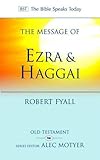
Book Review–The Message of Ezra and Haggai (Robert Fyall)

This is one of the most recent additions to the Bible Speaks Today series, and covers two books that fall into the post-exilic time-frame. Fyall recognizes that Ezra and Haggai are often neglected in favour of the slightly more accessible account of Nehemiah, and the more vivid prophecy of Zechariah. Nevertheless, he is determined to demonstrate to us that both books have a message for us today.
He identifies the main themes of Ezra as: God, the worship of God, the people of God, and Scripture and prayer. Its ongoing relevance is that it demonstrates that God never abandons his purpose or gives up on his people, but gives light for their guidance.

His approach is to work through the text, often making points of application along the way, but then a few pages at the end of each chapter are deliberately focused on what the contemporary message for the church is. Many of these points centre on the importance of the Word of God, the presence of God and the holiness of God.

The commentary on Haggai presents him as a prophet who had to confront a people like the church at Laodicea – tepid and complacent. Haggai’s style is blunt and succinct, with his prophecy a mixture of encouragement and rebuke. The temple for Haggai is the visible sign of God dwelling amongst his people by his Spirit. Fyall makes a point of showing how there is more going on here than simply a building project.

Overall I would say that I enjoyed working through this volume on two books of the Bible I don’t know particularly well. He gives enough background to help you piece together the timelines of the two books, but the focus throughout remains on finding what the Bible says today to our own situations.

Book Review: REBC Exodus (Walter Kaiser)

I have reviewed various other commentaries in this series (find them here) so I won’t repeat my comments on the layout of the series, which is very good.

226 pages are devoted to this volume on Exodus, which is bound with Sailhamer on Genesis and Hess on Leviticus. The introduction is brief. Kaiser says that Exodus was never intended to exist separately from the rest of the Pentateuch. He accepts Mosaic authorship and defends the historicity of the book:

we are left with no explanation for Israel’s appearance on the historical canvas at all when we try to explain the emergence of this nation and this time without the presence of a Moses or an Aaron.

Exodus is a book full of foundational theology – containing God’s revelation of his person, his redemption, his law and his worship. He broadly structures the book as follows:

  1. God’s plan for deliverance (chs 1-19)
  2. God’s plan for morality (chs 20-24)
  3. God’s plan for worship (chs 25-40)

His commentary on the first of those sections was I felt the best material. His analysis of the three-fold promise of Ex 6:6-8 is good, and he provides a helpful chart giving an overview of the plagues. His interest in linking the plagues to known natural phenomena of the time is fascinating (e.g. deducing what particular disease the cattle died of), but perhaps not altogether what I was looking for from this commentary. However, despite his willingness to see God working through non-miraculous means for many of the plagues, he is not anti-supernaturalist, and accepts several other miracles features in the account (e.g. the manna, after ruling out various naturalistic explanations).

Kaiser shows an Arminian bias in his comments on the hardening of Pharaoh’s heart, explaining God’s announcement in Ex 7:3 as the “occasion” but not the “cause” of his hardening. He makes an interesting point on Ex 12:3-11 and Ex 19:5-6, that God’s original intention was for the whole nation (i.e. not just the Levites) to be a nation of priests. Rather curiously this leads him to suggest that the “priests” of Ex 19:22 means everyone. He considers the “pillar of fire” to be the same as the “angel of the Lord”, which is also to be identified with the “shekinah glory”, which is Christ himself.

He sees the tabernacle as embodying the theology of worship – it signifies that God has come to dwell in the midst of Israel as he would one day come in the incarnation and will again in the second advent. He offers a few brief and tentative suggestions as to the symbolic significance of various items in the tabernacle. The commentary on this latter part of the book seems to speed up, to the point where chapters 36-39 are handled in one brief chunk, which mainly refers you back to his comments on the same topics earlier.

Since this commentary series has limited space, it is only reasonable to recognise that not every exegetical, historical and theological issue can be covered. But Kaiser’s interest in certain historical matters, such as whether crocodiles are to be found in the Nile, or what similarities the law might have with the Eshnunna Law, often meant that more pressing matters for expositors (which is who this series is aimed at) were left untouched. For example, preachers will probably want to wrestle with why some of the laws can seem unfair to us. Sadly, he opts to refer us to other works he has written on OT ethics without summarising his conclusions.

Overall then, I would say that this commentary on Exodus, while having some interesting insights here and there, didn’t quite scratch where I was itching, and I don’t think it fulfils the goal of being a commentary ideally suited to “expositors” (unless they are willing to supplement it with further reading). I’m going to try out Enns (NIVAC) or Stuart (NAC) next time I go through Exodus, as both those commentaries seem to be highly regarded.

Book Review – The Message of Judges (Michael Wilcock)

This volume in the Bible Speaks Today series contains a brief introduction and the full text of Judges from the RSV. As with many commentators on Judges, Wilcock highlights the recurring pattern of rebellion, retribution, repentance and rescue. However, he is also eager to point out that there are many things in the book that don’t fit neatly into that pattern. In fact, he argues that rather than having a cyclic structure, the book of Judges portrays a downward spiral.

His comments on Ehud are interesting. Ehud is the story of the unexpected. Wilcock considers it more likely that he was disabled in his right hand rather than left-handed per se. Ehud is in fact the first of a whole series of unlikely heroes that characterise the book of Judges. The rescuers God sends so often come from the places we least expect (as was true of Jesus).

God repeatedly allows his people to get their fingers burned in order that they come to see that ‘Canaan’ is in fact the great enemy. With each rotation of the cycle (or spiral), we see how shallow Israel’s repentance is.

Another interesting section is on Jephthah – another unlikely hero, “despised and rejected by men”. He discusses how come Jephthah comes to get a mention in Heb 11:32 for being a man of faith, despite doing what seems a shockingly immoral act. Jephthah had not “heard” many of God’s commands, but he had at least heard the command to keep your word.

The final judge, Samson, was a man who had the Spirit, but not wisdom, or a “clean heart and a right spirit”. But even in the story of Samson, Wilcock points out parallels with the story of Jesus – handed over to death by his own people, and winning a great victory in his death.

Judges ends with a shocking account of just how far Israelite society had fallen morally, with God virtually absent in the closing chapters. But yet he declares that the book of Judges is ultimately a story of grace. God doesn’t abandon his people, though they richly deserve it, but ensures they don’t completely destroy themselves by their own wilful folly.

Although the commentaries of Dale Ralph Davies on the Old Testament Historical books remain firm favourites of mine, I have to say that I enjoyed Wilcock’s approach to Judges, particularly his attention to how each judge’s story contributes to the overall message of the book.

Forthcoming Commentaries 2010

There haven’t been many commentaries published so far this year that have really got me excited (Peter O’Brien on Hebrews being the notable exception). But all that is set to change with a bumper crop of commentaries set to come out just in time for Christmas. Here’s my pick of the bunch.

New Testament Bonanza

One of the newest series, the Zondervan Exegetical Commentary (which covers the New Testament) has three new volumes scheduled for later this year. Matthew by Grant Osbourne, Galatians by Thomas Schreiner and Ephesians by Clinton Arnold. All three are exciting, although Galatians is probably the one I will prioritise getting as I am looking forward to Schreiner’s take on the New Perspective. I have the ZEC commentary on James and it looks to be a very nice format.

We’re treated to another significant Ephesians commentary this year as Frank Thielman’s Ephesians in the Baker Exegetical Commentary series is due out in November. The BEC volumes I have read have all been excellent and are usually very competitively priced.

There is also a major new commentary on the gospel of John by Ramsey-Michaels in the NICNT series. At 1122 pages, this one will should prove an excellent companion to my current favourite on John by Don Carson in the Pillar Series.

Speaking of Don Carson, the revision of his commentary on Matthew in the Expositor’s Bible Commentary series is finally due out. The first edition published in 1984 was simply outstanding, and I look forward to reading his interaction with more recent commentators. The volume also includes a revision of Mark by Wessell and Strauss.

Carson is also the editor of the Pillar series, which has a new volume on 1 Corinthians coming out by Roy Ciampa and Brian Rosner. I don’t know a lot about the authors, but it will be nice to get something else to complement my current favourite on 1 Corinthians in the NICNT series by Gordon Fee.

Which nicely links me to the rumour that Fee’s commentary on Revelation in the NCCS series is due out soon. Fee’s commentaries never disappoint, so I am sure it will be worth getting hold of.

Old Testament

On the Old Testament side of things I tend to focus on the more intermediate level commentaries and there is a good helping of those coming out soon.

The Bible Speaks Today series seems to have awoken from its slumber and is filling in some of the remaining gaps in its Old Testament coverage. Gordon Bridger has the task of bringing the somewhat gloomy books of Obadiah, Nahum and Zephaniah to life, while Robert Fyall tackles Ezra and Haggai.

The revision of the Expositor’s Bible Commentary takes another step towards completion with the release of a volume on 1 Chronicles – Job featuring several contributors including Tremper Longman III on Job. And the Cornerstone series, also nearing completion, has two new volumes. Ezekiel and Daniel by Thompson and Carpenter and Ezra, Nehemiah and Esther by Gary Smith.

On the slightly more technical side, the Apollos OT commentary series has a new volume on Joshua by Pekka Pitkanen. And there is an interesting looking commentary on the Psalms by Waltke and Houston, which is not part of any series.

As always, the definitive guide to what’s coming up is the forthcoming commentaries blog post by Jeremy Pierce (Parableman).

Book Review – The Message of 2 Corinthians (Paul Barnett)

Paul Barnett is also the author of the much larger volume on 2 Corinthians in the New International Commentary series, so this book is clearly his area of expertise. Having said that, I think that this contribution to the Bible Speaks Today series precedes his work for the NICNT.

2 Corinthians is a more personal and emotional letter than 1 Corinthians, but that does not mean it is without theological contributions. Barnett picks out several of these in his introduction including teaching on the new covenant, the death of Christ, and giving.

As he works through the early chapters, Barnett explains the nature of the opposition that Paul is facing from the “super-apostles”, who he sees as having an Old Covenant mentality. He highlights several places in which Paul’s Damascus road experience is behind what he says.

Perhaps some of the best material is the discussion of the relation of the Old to New Covenants, which he explains as “promise” and “fulfilment” – there is continuity between them. Paul opposes a “back to Moses” program, but is not anti-law. “Until the law had been internalised by the Spirit, it remained a letter, which kills.”

Barnett sees “God’s strength in weakness” as the chief theological theme that ties together the whole letter. The new ministers in Corinth, unlike Paul, had nothing to say about suffering, death and judgment – theirs was a superficial message. They were fixated on Israel, the temple, and the law – “things seen not unseen” (2 Cor 4:18).

He makes an interesting point on 2 Cor 5:11,14 that Paul’s two motivations were fear of the Lord and love – these two are not incompatible. He explains the teaching on the atonement in 2 Cor 5:21 by saying that Christ’s death is for us both as representation and as substitution.

Another strength is Barnett’s comments on the nature of true Christian leadership, which is sacrificial rather than boastful and triumphalist. “Sacrifice is at the heart of the gospel and also at the heart of ministry.”

The age of the book is betrayed as he discusses how Christians are to share their surplus, rather than indulge in luxuries such as microwaves and “videos”, though the point is just as timely:

Through our labours many of us have more than we need. But to what extend to we give to those in need? Instead, those who have one house buy a holiday home; those who have progressed from black and white to colour television add a video; those who have an ordinary oven want a microwave too. The surplus is for sharing; but few of us do so.

This is the only commentary on 2 Corinthians I have read so I have nothing to compare it to, but overall I would say it fulfils the goals of the Bible Speaks Today series admirably. It explains the meaning of the text clearly and brings out plenty of helpful doctrinal and practical application. 2 Corinthians can be a bit neglected since much of the material is directly about Paul and countering the “new ministers” in Corinth, but Barnett shows that the letter still has much to say to us today.

Book Review – The Message of Ecclesiastes (Derek Kidner)

This is one of the earliest volumes of the Bible Speaks Today series, having been written in 1976 and only later incorporated into the series. In a brief introduction Derek Kidner asks what Ecclesiastes is doing in the Bible. He introduces us to the author, Qoheleth. He thinks that this teacher puts himself in the shoes of a “super-Solomon” for the purposes of writing the book.

Kidner interprets the book as being written from “ground level” – the author deliberately views life “under the sun” from a human perspective – if you like, from a secularist vantage point. Qoheleth will explore path after path to the point that it comes to nothing, and in the end, only one way will be left.

Kidner makes regular references to various stories, quotes or poems that make similar points to Ecclesiastes. In Eccl 3:1-8, he does not take the common approach of assuming it is about the idea that there is an “appropriate” time” for every activity. Rather he sees it as a comment on the perpetual pattern of change – everything has a beginning and an end. However, he does see Eccl 3:11 as a key verse – part of the very reason that we find so many seemingly good things unsatisfying is that we have eternity in our hearts.

Every few chapters, Kidner inserts a brief “backwards glance”, summarising the argument so far, which is a helpful touch. He thinks that Qoheleth’s mission, like Jeremiah, is first to tear down and destroy before he eventually gets round to building up (Jer 1:10). Kidner sees a turning point coming after Ecclesiastes 9, by which time Qoheleth has made his case against human self-sufficiency.

Overall I think Kidner has done a good job of interpreting the train of thought in this book that can be quite perplexing at times. I find it interesting that many of the better known verses in Ecclesiastes seem to have a different meaning to their popular interpretations when considered in the light of the whole book’s progression of thought.

Book Review – Hebrews For Everyone (Tom Wright)

Series Overview

The “For Everyone” series is Tom Wright’s project to write an accessible commentary / devotional on the entire New Testament. He brings his massive scholarly learning to the table, but these volumes are anything but dry academic tomes.

The unique features of the series include the author’s own translation, which is a fairly loose paraphrase in many places. There is no book “introduction”, so if authorship and dating are covered, it is only in passing as he goes through. And he always starts each section with a brief anecdote, from his seemingly endless supply of illustrations, almost all of which prove helpful in illuminating the text although there are rare occasions where one suspects he was a little short of ideas.

His quirky approach to capitalisation from his more academic tomes also shows up in these books (e.g. “holy spirit”), although “God” does get capitalised throughout. Finally, there is a glossary at the back in which he defines several key terms which are highlighted in bold throughout the book.

Hebrews Commentary

Hebrews rests heavily on Old Testament quotations and allusions, and Tom Wright does a good job of explaining first the sense of the OT passage before showing how it functions in the author of Hebrews’ argument.

A strong theme comes out of Jesus as the climax of biblical history. Wright explains that the law is a good thing, but a temporary, preparatory thing, and so why go back to it, now the real thing has arrived. Moses matters – but Jesus matters even more.

Much of his familiar work on our future hope can be detected in this commentary, as he reminds us that we are not expecting to go from a material present to a spiritual (i.e. non-material) future, but rather we look to a world in which evil has at last no place. He does see a reference to the second coming in Heb 9:28, although is somewhat equivocal about Heb 10:37 which he starts off calling a reference to the second coming, but ends up linking it to the temple destruction in AD70.

Whilst he does not engage in the “once-saved always saved” debate in the way that other evangelicals might, he does tip his hand towards a perseverance of the saints position, saying that Rom 5-8 shows you can’t become a Christian and lose it all. Along with most interpreters he sees a major purpose of the author to encourage his readers to keep persevering in the face of persecution.

Verdict

Tom Wright has the knack for bringing a fresh perspective to just about every topic he approaches and this is no exception. Preachers will find this especially useful as a source for illustrations and fresh ways of saying things. It shouldn’t be the only thing you read on Hebrews, but it nevertheless is well worth getting hold of, especially if, like me, you sometimes find Hebrews a bit heavy-going.

Book Review – NIVAC Esther (Karen Jobes)

The NIV Application Commentary series takes a unique approach. It contains the full text of the NIV for the passage under commentary, but then deals with it under three headings. First is “original meaning”, which is essentially the material that would be found in a traditional commentary. This seeks to explain the meaning of the text, explaining the historical situation and meaning of words. The second is called “bridging contexts”. This section seeks to build a bridge between the world of the original hearers, and ours, separating what we might call the “timeless” principles or truths, from that which was tied to a specific point in history. Then in the section entitled “contemporary significance” the commentator is given free rein to give contemporary application of one or more of the principles identified in the bridging contexts section. Essentially this section serves as an example of how a preacher might apply the text to a modern congregation.

In a 30 page introduction Jobes outlines some of the unique features of the book of Esther, including its notable lack of reference to God or anything explicitly religious, and the enigma of why some Jews had chosen not to return to Jerusalem at this point. She identifies “reversal of destiny” (or “peripety”) as a key theme of the book, and the providence of God as the main theological lesson. The book of Esther teaches that the Jews still are God’s covenant people, even with no temple, no city and no prophet.

For the most part, Jobes deals with a chapter at a time, although some are broken into smaller chunks. She is cautious in her approach to application, rightly noting the dangers of an “exemplary” approach to hermeneutics (i.e. deciding that everything Esther or Mordecai does is there as a good example for us to follow). Indeed, she shows that there is a good deal of moral ambiguity about their actions, and they may show signs that the Jews in Persia have become secularised to some extent. In any case, the point of the story is not to say whether Esther and Mordecai did right or not, but that God’s covenant purposes were providentially fulfilled through them.

She picks up an idea from Ryken that Esther’s two names suggest a dual identity – she is the king’s wife and a Jew. As the story progresses, these two identities must merge into one. She discusses the challenges of how as Christians we attempt to live within our culture without compromising our values.

As with several other commentators, Jobes shows the link between Mordecai and Haman’s conflict and that of Saul and Agag. She argues persuasively that we are to see the counter-decree as an example of “holy war”. This explains why no plunder was taken, despite it being permitted.

The death of Jesus Christ, the Messiah of Israel, provides the only basis for the cessation of holy war, and the infilling of the Holy Spirit provides the only power by which one may love one’s enemies as oneself

One strength of the bridging contexts sections, is how Jobes always seeks to interpret the events of Esther in the light of the gospel. She never uses allegories or even suggests that the events foreshadow the gospel, but she does nevertheless keep approaching topics in the light of the cross and new covenant.

Much of the discussion relates to “providence”, and Jobes shows how “God works mysteriously, patiently, and inexorably through a series of ‘coincidental’ events and human decisions, even those based on questionable motives and evil intents.” She includes a ten page postscript examining the doctrine of divine providence in a bit more detail.

Her analysis of the structure of Esther is very interesting. She shows how feasts are central to the narrative, and that the book starts with a pair of feasts, has another pair of feasts in the middle and ends with a pair of feasts. This leads her to conclude that the “pivot point” of the book is the king’s sleepless night. In other words, neither Esther nor Mordecai do anything to “turn” events into their favour – it is the providential work of God in a seemingly insignificant occurrence that changes everything. She also shows how the reversal of fortunes of both Haman and Mordecai are arranged in a chiastic structure.

Obviously, the book of Esther brings up various issues relating to women in particular. Jobes does not see this as central to the book’s message, noting that the main adversarial relationship in the book is not between male and female but between the Jews and their enemies. However, she does give some helpful thoughts in the final chapter on male and female partnerships, noting how Esther and Mordecai worked together as “lay leaders” in “secular vocations”. She also emphasises that being a wife or mother on one hand, or being ordained on the other, by no means exhaust the possibilities of vocations, and that much of the debate has been too narrowly focused.

Overall I have to say this is an outstanding contribution to the NIV application series, and I found it very helpful and thought provoking. This is the second of Jobes’ commentaries I have read (the first being her BEC commentary on 1 Peter which was also excellent) and I will be eagerly looking out for any forthcoming volumes from her.

Book Review – The Message of Acts (John Stott)

This volume of the Bible Speaks Today series runs to over 400 pages (plus study guide), making it one of the longest in the series. Rather than simply providing commentary on the text, Stott seeks to show how the message of Acts applies to us today.

I have tried, therefore, to address myself with integrity to some of the main questions which the Acts raises for today’s Christians, such as the baptism of the Spirit and charismatic gifts, signs and wonders, the economic sharing of the first Christian community in Jerusalem, church discipline, the diversity of ministries, Christian conversion, racial prejudice, missionary principles, the cost of Christian unity, motives and methods in evangelism, the call to suffer for Christ, church and state, and divine providence.

His attention to contemporary issues raised by the text makes this commentary a much more vibrant read than several other commentaries I have read on Acts (TNTC by Howard Marshall, NICNT by F F Bruce, NIBC by David Williams). Stott does address issues of historicity, geography and historical background, but not to the same depth as these other commentaries, leaving him plenty of space to reflect on theology and practical application.

The group of churches I am part of, newfrontiers, tends to favour different interpretations of the book of Acts to Stott in several places. First of all, Stott is convinced that the concept of an “apostle” belongs to the first century only, arguing that there are no more apostles today, since apostles must be directly appointed by Christ. This causes him to make less emphasis on Paul’s church planting methods and relationship with those churches as a paradigm for modern day church planting and apostolic ministry.

Second, Stott is not a charismatic, and so plays down expectations that gifts of tongues and prophecy as well as signs and wonders may occur today. Third, he strongly disagrees with the Pentecostal (and Catholic) understanding of baptism in the Spirit as distinct from conversion. There are other places where his Anglicanism is noticeable, such as his plea not to abandon the “institutional church”, as well as his views on the mode of baptism.

Notwithstanding these differences of opinion, there is a wealth of profitable material to be gleaned from this commentary. He highlights some interesting parallels between Luke’s gospel and Acts, including the way Paul’s journey to Jerusalem mirrors Jesus’ journey to Jerusalem. In addition, the arrest and trial narratives of both Jesus and Paul have various parallels. Another is the similarity between the Emmaeus road and Ethiopian eunuch stories. By telling these stories in parallel ways, Luke shows how the early believers (and Paul especially) walked in the steps of Jesus.

Just as the Spirit came upon Jesus to equip him for his public ministry, so now the Spirit was to come upon his people to equip them for theirs.

Though he does not take it up at every point, Stott chooses a few key places to defend the historicity of Luke’s account, such as the ascension and the relationship between the three tellings of Paul’s conversion.

Stott brings out plenty of helpful principles for evangelising and for communicating the gospel as he works through the various stories of the mission of the early church, especially in how different approaches were needed for those of different religious and cultural backgrounds.

Although in Acts 19:1-6 Stott is adamant that the Ephesian disciples were clearly not believers, his language sounds remarkably similar to David Pawson’s concept of the “normal Christian birth” consisting of distinct elements:

The norm of Christian experience, then, is a cluster of four things: repentance, faith in Jesus, water baptism and the gift of the Spirit. Though the perceived order may vary a little, the four belong together and are universal in Christian initiation.

Though Stott’s views on the Spirit will not be agreed with by those like myself from newfrontiers, we do find a lot of common ground on his comments on eldership. He sees eldership as being “local” and “plural”, with no pyramid structure, but rather a team. “Elders”, “pastors” and “overseers” are all terms referring to the same office.

This was my second reading of Stott’s commentary on Acts, and it only serves to cement its place as my favourite on this book. I would recommend consulting it to all who preach from or study the book of Acts.

Book Review – The Message of Esther (David Firth)

The Bible Speaks Today series is still missing a few Old Testament volumes, and it has been a while since a new one came out, but it looks as if they are rectifying this, with this volume on Esther being published recently and a couple more due to come out later in the year (Obadiah, Nahum & Zephaniah by Gordon Bridger and Ezra & Haggai by Robert Fyall).

Introduction

The introduction fills us in on the historical background to Esther, and tells us about the three versions there are of the book. Firth describes the book of Esther as a ’dramatized history’. He introduces us to each of the main characters, and explains the significance of Haman being an ‘Agagite’.

Commentary

Though the book of Esther is notable for its lack of explicit mention of God, Firth does think we can detect various allusions to other Biblical passages. He is cautious not to read more into the text than the author says, but on the whole interprets Mordecai and Esther’s decisions positively – e.g. “Esther neither sought entry to the harem, nor advancement within it, yet both came to her”. He does however think it likely that her failure to reveal her Jewish identity would inevitably mean that she could not retain a kosher lifestyle.

He draws out lessons of remaining faithful to God’s purposes, even in an antagonistic culture, and it is as we do this that we see his providence at work. He picks up on the foolishness of alcohol-fueled decision making. He also reflects on the need for God’s people to challenge evil when we see it, and to speak out from a biblical perspective, taking the risks of faith that God has led us to.

He sees Esther as embodying wisdom in contrast to Haman’s folly. As one would expect there is plenty of discussion of the providence of God, working in ways and with timing that are not what we would expect. He attempts to soften the rather bloodthirsty sounding edicts issued by Esther, by proposing that they were only to be fulfilled in self-defence against those who explicitly attacked the Jews.

Verdict

I found this an interesting read and a good guide to the book of Esther. It fulfils the goals of the Bible Speaks Today series as it both illuminates the text and draws out principles for application. Sometimes I wondered whether he overlooked some of the moral ambiguities surrounding Mordecai and Esther’s behaviour. There was no real attempt to find echoes of the gospel story in the book. Arguably that may be a good thing, as those who do so often seem to need to put a lot of “spin” on various characters and events to make it fit, but I would have appreciated some discussion of where Jesus is to be found within the book. My favourite Esther commentary is Karen Jobes’ NIVAC commentary, but this one has a slightly different perspective so complements it well.