
pursuing faithfulness to the Word of God and fullness of the Spirit of God
| Print article | This entry was posted by Mark Heath on January 31, 2010 at 9:07 pm, and is filed under Book Reviews, Commentaries. Follow any responses to this post through RSS 2.0. You can leave a response or trackback from your own site. |
No comments yet.
Book Review – BEC John (Andreas Köstenberger)
about 1 month ago - 2 comments
The Series
The Baker Exegetical Commentary series is one of my favourites in terms of layout, with very nice typesetting which sets it apart from series like the Word Biblical Commentary or even the Pillar New Testament Commentary series. It is good to see newer series following suit. The full text of the book is included More >
The “Love Languages” of Jesus
about 1 year ago - 6 comments
I’m sure most of my readers have heard of the “five love languages”. The idea is that different personality types appreciate different ways of love being expressed. These are:
Quality Time
Receiving Gifts
Words of Affirmation
Acts of Service
Physical Touch
The idea is that if we discover what someone’s “love language” is, we can better More >
Convicted of Righteousness
about 1 year ago - 6 comments
8 And when he comes, he will convict the world concerning sin and righteousness and judgment: 9 concerning sin, because they do not believe in me; 10 concerning righteousness, because I go to the Father, and you will see me no longer; 11 concerning judgment, because the ruler More >
Book Review – EBC Matthew (D A Carson)
about 3 years ago - No comments
Despite being written back in 1984 and being part of a series that generally is not considered an “in depth” level of commentaries, Don Carson’s volume on Matthew still consistently finds its way to the top of most evangelical lists of recommended commentaries on the first gospel. It is, in fact, considerably more detailed than More >
Book Review – John For Everyone (Tom Wright)
about 4 years ago - 3 comments
The gospel of John is covered in two volumes of Tom Wright’s “For Everyone” series. The basically format is that he provides his own translation of the text (say 10-20 verses) followed by a page or two of expositional and devotional thoughts. These usually begin with a brief anecdote or illustration, and go on to More >
The Message of John (Bruce Milne)
about 4 years ago - 2 comments
In this generously sized volume of the BST series, Bruce Milne guides us through the gospel of John. Regular readers of this series will know that they can expect an evangelical commitment to Scripture, and a focus on expository preaching that brings home the theological and moral implications of the text to contemporary readers.
The introduction More >
Commentary Series Review – Pillar New Testament Commentary
about 4 years ago - 8 comments
The Pillar commentary series has been slowly but surely growing for well over 15 years now, with eight published volumes, and authors assigned for all the remaining ones. In fact, it would appear that some of the earliest volumes are already in line for replacement. The target audience seems to be pastors and undergraduate level More >
Book Review – The Letters of John (Colin Kruse)
about 4 years ago - No comments
As I have studied through 1 John recently, I have noticed that while the author manages to make his main points abundantly clear (e.g. the importance of loving one another), he uses lots of sentences along the way that are somewhat cryptic. In his Pillar commentary, Colin Kruse has managed to shed considerable light on More >
Book Review – The Pillar Commentary on Thessalonians (Gene Green)
about 4 years ago - 1 comment
This latest addition to the Pillar series of commentaries is reminiscent of O’Brien’s Pillar Commentary on Ephesians in that it has a long introduction (75 pages), which includes a critique of the rhetorical analysis approach to the epistles and defends Pauline authorship. He also explains why he is not convinced by arguments placing 2 Thessalonians More >
Book Review – The Pillar New Testament Commentary on Ephesians (Peter T O’Brien)
about 4 years ago - 3 comments
Peter O’Brien has earned himself the reputation of being a fine scholar and commentary writer, specialising in the Prison epistles, having written highly acclaimed volumes on Philippians for the New International Greek Testament Commentary and Colossians and Philemon for the Word Biblical Commentary. This work on Ephesians thus completes the set, and although the Pillar More >
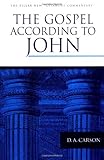
Book Review – The Gospel According to John (D A Carson)
I have already blogged about the Pillar New Testament Commentary series, which is itself edited by Don Carson, so you can read my general thoughts on the layout and goals of this series there.
The Introduction
The introduction is fairly lengthy (80 pages), and dives straight in with a look at the distinctives of the gospel of John as compared to the Synoptics. Carson has of course also authored a commentary on Matthew that paid special attention to the relationship between the Synoptics, so this enables him to complete the picture.
He devotes several pages to the historical interpretation of John’s gospel, before embarking on a lengthy defence of the authenticity of the fourth Gospel. In particular, he addresses Bultmann’s antisupernaturalism and ‘demythologizing’ of the text. He points out that the Dead Sea scrolls find has removed the need to postulate a hellenistic background to the thought of John’s gospel.
Another sizable section is devoted to authorship, in which he casts doubt on the validity of efforts to detect several sources in the text. He concludes that a working assumption of Johannine authorship is the best way to approach the text. He very tentatively dates it at around AD 80.
Carson even includes some advice for those preaching from the book of John. Overall the introduction is a great read, and almost a book in its own right.
The Commentary
The commentary itself is densely packed in with little whitespace, and no inclusion of the biblical text. There are surprisingly few footnotes, since Carson prefers to do most of his interaction with other commentators in the main text. As with his Matthew commentary, he loves to take the time to defend the text against accusations of fabrication, and offers explanations for supposed problems. He is also quite happy to spend several pages digging deeper into a particular theological concern that is raised by the text.
The commentary itself is far too massive for me to attempt to summarise all the useful points. To list all the sections of John in which I found Carson’s comments particularly helpful I would be to list the entire contents.
Carson’s strengths as a biblical commentator are the comprehensive way he tackles the types of concern that an expositor will have. He incisively gets to the bottom of what the sayings mean, some of which are hard to unpack. He has a good eye for Old Testament allusions. He is willing to take on and reject other possible interpretations, both from skeptics and other Christian traditions (such as Roman Catholicism). He is also prepared to reject “sentimental” conclusions popular amongst evangelicals if the exegesis does not bear it out.
Conclusion
I cannot recommend this commentary on John highly enough. It is a magnificent work, and one that would greatly benefit any serious student or teacher of the Bible. Yes, it is quite long, but it is always interesting. It has actually taken me about five years to work my way through it, but I am glad I have done so, and this will almost certainly be one of the first commentaries I consult every time I am doing study on John.